Satellite News

Satellites are used for a large number of purposes. Common types include military (spy) and civilian Earth observation satellites, communication satellites, navigation satellites, weather satellites, and research satellites.

Thumbnail Recent Post

NASA Probe Sees Solar Wind Decline

The 33-year odyssey of NASA's Voyager 1 spacecraft has reached a distant point at the edge of our solar system where there is no outward motion of solar wind. Now hurtling toward interstellar space some 17.4 billion...

Super-Earth Atmosphere

A team of astronomers, including two NASA Sagan Fellows, has made the first characterizations of a super-Earth's atmosphere, by using a ground-based telescope...

Kepler Discovers

NASA's Kepler spacecraft has discovered the first confirmed planetary system with more than one planet crossing in front of, or transiting, the same star...

Pulverized Planet

Tight double-star systems might not be the best places for life to spring up, according to a new study using data from NASA's Spitzer Space Telescope....

Dark Asteroids

NASA is set to launch a sensitive new infrared telescope to seek out sneaky things in the night sky -- among them, dark asteroids that could pose a threat to Earth....

NASA's lunar-bound GRAIL twins were mated to their Delta II launch vehicle at the Cape Canaveral Air Force Station's Launch Complex 17 at 8:45 a.m. EDT (5:45 a.m. PDT) today. The 15-mile (25-kilometer) trip from Astrotech Space Operations in Titusville, Fla., is the last move for GRAIL before it begins its journey to the moon. NASA's dynamic duo will orbit the moon to determine the structure of the lunar interior from crust to core and to advance understanding of the thermal evolution of the moon.

"We are about to finish one chapter in the GRAIL story and open another," said Maria Zuber, GRAIL's principal investigator, based at the Massachusetts Institute of Technology in Cambridge. "Let me assure you this one is a real page-turner. GRAIL will rewrite the book on the formation of the moon and the beginning of us."

Now that the GRAIL spacecraft are atop their rocket, a final flurry of checks and tests can begin to confirm that all is go for launch. The final series of checks begins tomorrow, Aug. 19, with an on-pad functional test. The test is designed to confirm that the spacecraft is healthy after the fueling and transport operations. Next week, among all the upcoming final tests, reviews and closeout operations leading up to liftoff, the GRAIL team will install the launch vehicle fairing around the spacecraft.

GRAIL's launch period opens Sept. 8 and extends through Oct. 19. On each day, there are two separate instantaneous launch opportunities separated in time by approximately 39 minutes. On Sept. 8, the first launch opportunity is at 8:37 a.m. EDT (5:37 a.m. PDT). The second launch opportunity is 9:16 a.m. EDT (6:16 a.m. PDT).

NASA's Jet Propulsion Laboratory, Pasadena, Calif., manages the GRAIL mission. The Massachusetts Institute of Technology, Cambridge, is home to the mission's principal investigator, Maria Zuber. The GRAIL mission is part of the Discovery Program managed at NASA's Marshall Space Flight Center in Huntsville, Ala. Lockheed Martin Space Systems, Denver, built the spacecraft. Launch management for the mission is the responsibility of NASA's Launch Services Program at the Kennedy Space Center in Florida. JPL is a division of the California Institute of Technology in Pasadena.

Wilcutt is a retired Marine colonel and veteran astronaut who is serving as director of safety and mission assurance at NASA's Johnson Space Center in Houston. He will assume the post from Bryan O'Connor, who will retire from the agency on Aug. 31.

NASA Administrator Charles Bolden announced the appointment Tuesday.

"As NASA looks beyond the space shuttle to new programs of human exploration, technology development and scientific research, we remain committed to the highest standards for mission success and the well-being of our work force," Bolden said. "Terry Wilcutt has more than 20 years of experience in human spaceflight and safety, as well as the integrity and courage necessary to lead what arguably is NASA's most important support organization, the Office of Safety and Mission Assurance, and serve as my conscience on issues of safety as did Bryan O'Connor during our time together. I am delighted Terry stepped forward to guide us safely into the future."

In his new role, Wilcutt will be responsible for the development, implementation and oversight of safety and mission assurance policies and procedures for all NASA programs.

"I look forward to continuing Bryan's work and to meeting the challenges of the next chapter in human space exploration as well as the rest of NASA's diverse portfolio," Wilcutt said.

Wilcutt joined NASA as an astronaut in 1990. He was the pilot on two space shuttle missions, STS-68 in 1994 and STS-79 in 1996. He commanded two others, STS-89 in 1998 and STS-106 in 2000. He served as manager of safety and mission assurance for the Space Shuttle Program, and as Johnson's deputy director of safety and mission assurance before becoming director in 2008.


NASA’s groundbreaking Robotic Refueling Mission (RRM) will reach a key milestone in September when the International Space Station (ISS) robots transfer the module to its permanent home on space station’s ExPRESS Logistics Carrier-4. Robotic operations for the technology demonstration are currently slated to begin soon afterwards.

A joint effort between NASA and the Canadian Space Agency, RRM is designed to demonstrate the technologies, tools, and techniques needed to robotically service satellites, especially those not built with servicing in mind.

The results of this two-year technology test bed are expected to the reduce risks associated with satellite servicing as well as lay the foundation and encourage future robotic servicing missions. Such future missions could include the repair and repositioning of orbiting satellites.

President Obama called the RRM demonstration “innovative” during a July 15 phone call to STS-135 astronauts onboard the ISS noting its potential future benefits to the commercial satellite industry. “It’s a good reminder of how NASA technology and research often times has huge spillover effects into the commercial sector, and makes it all that much more important in terms of peoples’ day to day lives.”

Launched to the ISS in July onboard the last shuttle mission, RRM marks the first use of the space station’s Dextre robot beyond robotic station maintenance for technology research and development. It is also the first on-orbit demonstration to test, prove and advance the technology needed to perform robotic servicing on spacecraft not designed for refueling and repair.

"Robotic refueling and satellite servicing could extend the lifetimes of satellites, offering significant savings in delayed replacement costs," said Frank Cepollina, Associate Director of the Satellite Servicing Capabilities Office (SSCO) at NASA’s Goddard Space Flight Center. "Such servicing has the potential to allow human and robotic explorers to reach distant destinations more efficiently and effectively."

The RRM module is about the size of a washing machine and weighs approximately 550 pounds, with dimensions of 33" by 43" by 45.” RRM includes 0.45 gallon (1.7 liters) of ethanol that will be used to demonstrate fluid transfer on orbit.

On July 12, space station astronauts Mike Fossum and Ron Garan removed the RRM module from the cargo bay of shuttle Atlantis and placed the module onto a temporary platform on the Dextre robot. In September, the Canadarm2 robot will permanently secure RRM on the ExPRESS Logistics Carrier-4 (ELC-4), an external platform also built at Goddard. The ISS will provide command, telemetry and power support for the module through ELC-4 during the experiment’s two-year window of operations.

After the transfer to ELC-4, mission operators will release the launch locks on the four RRM tools to be used at a later date by Dextre. This will be followed by a series of vision tasks, to develop machine vision algorithms against the harsh lighting on orbit verifying the RRM can see during future demonstrations.

The first set of refueling demonstration tasks are currently scheduled for January 2012. These activities will verify that on-orbit satellite repairs can be performed with today’s technology.

Satellite servicing with astronauts is not new for NASA. Skylab, NASA's first space station, was repaired in space in 1973. Solar Maximum and Syncon IV, with help from the shuttle, were successfully repaired in the 1980's. In the 1990's NASA serviced the Compton Gamma Ray Observatory, Intelsat 6 and executed a series of highly successful servicing missions to the Hubble Space Telescope.

"You know NASA has been doing space servicing for quite some time now," said Cepollina. "We will be demonstrating abilities that will allow for the servicing of existing satellites and could influence the build of future satellites to allow easy on-orbit access for refueling and repair."

More recently, human and robotic servicing capabilities have contributed to the assembly, upkeep and repair of the ISS. With RRM, NASA can begin the work of confirming the robotic satellite-servicing technologies needed for the development of future robotic servicing spacecraft.

Cepollina believes it is just a matter of time before such servicing could become routine. "If we are to venture further from Earth, the need for robotic servicing will increase," said Cepollina. "With the build of the space station we see the increase of collaboration between human and robotic abilities in space servicing."

RRM operations will be entirely remote controlled by flight controllers at Goddard, Johnson Space Center, Marshall Space Flight Center, and the Canadian Space Agency's control center in St. Hubert, Quebec. The station's two-armed robotic system, Canada’s Special Purpose Dexterous Manipulator, or “Dextre,” will manipulate the tools necessary for the demonstrations.

Included within the RRM module are four unique tools developed at Goddard: the Wire Cutter/Blanket Manipulation Tool, the Multifunction Tool, the Safety Cap Removal Tool, and the Nozzle Tool. Each tool will be stowed in its own storage bay until Dextre retrieves it for use. Each tool contains two integral cameras with built-in LEDs to give mission controllers the ability to see and control the tools.

Drawing upon 20 years of experience servicing the Hubble Space Telescope, NASA’s SSCO initiated the development of RRM in 2009. Atlantis, the same shuttle that carried tools and instruments for the final, astronaut-based Hubble Servicing Mission 4, launched RRM to space. The last shuttle mission carried the first step to robotic refueling and satellite servicing to orbit—a new era sprung from the old.

The ultimate dream for any school student would be to make it to in the US and win a competition there. Students of Bishop Cotton Boys School did precisely that - win the international prize for designing a settlement on Mars. They were joint winners in the Asian final with a Pakistan school.

Bishop Cotton, along with three other schools - from USA, Romania and UK - all of whom were part of `one company' that designed the settlement of Mars, was declared international winners of the space settlement design competition for 2011 organized by Nasa on July 30, 31 and August 1 at the Johnson Space Center, Houston, USA.

The Herschel Space Observatory's large telescope and state-of-the-art infrared detectors have provided the first confirmed finding of oxygen molecules in space. The molecules were discovered in the Orion star-forming complex.

Individual atoms of oxygen are common in space, particularly around massive stars. But, molecular oxygen, which makes up about 20 percent of the air we breathe, has eluded astronomers until now.

"Oxygen gas was discovered in the 1770s, but it's taken us more than 230 years to finally say with certainty that this very simple molecule exists in space," said Paul Goldsmith, NASA's Herschel project scientist at the agency's Jet Propulsion Laboratory (JPL) in Pasadena, Calif.

Goldsmith is lead author of a recent paper describing the findings in the Astrophysical Journal. Herschel is a European Space Agency-led mission with important NASA contributions.

Astronomers searched for the elusive molecules in space for decades using balloons, as well as ground- and space-based telescopes. The Swedish Odin telescope spotted the molecule in 2007, but the sighting could not be confirmed.

Goldsmith and his colleagues propose that oxygen is locked up in water ice that coats tiny dust grains. They think the oxygen detected by Herschel in the Orion nebula was formed after starlight warmed the icy grains, releasing water, which was converted into oxygen molecules.

"This explains where some of the oxygen might be hiding," said Goldsmith. "But we didn't find large amounts of it, and still don't understand what is so special about the spots where we find it. The universe still holds many secrets."

The researchers plan to continue their hunt for oxygen molecules in other star-forming regions.

"Oxygen is the third most common element in the universe and its molecular form must be abundant in space," said Bill Danchi, Herschel program scientist at NASA Headquarters in Washington. "Herschel is proving a powerful tool to probe this unsolved mystery. The observatory gives astronomers an innovative tool to look at a whole new set of wavelengths where the tell-tale signature of oxygen may be hiding."

Herschel is a European Space Agency cornerstone mission, with science instruments provided by consortia of European institutes. NASA's Herschel Project Office is based at JPL, which contributed mission-enabling technology for two of Herschel's three science instruments.


NASA's Juno spacecraft completed its last significant terrestrial journey today, July 27, with a 15-mile (25-kilometer) trip from Astrotech Space Operations in Titusville, Fla., to its launch pad at the Cape Canaveral Air Force Station. The solar-powered, Jupiter-bound spacecraft was secured into place on top of its rocket at 10:42 a.m. EDT (7:42 a.m. PDT).
Juno will arrive at Jupiter in July 2016 and orbit its poles 33 times to learn more about the gas giant's interior, atmosphere and aurora.


"We're about to start our journey to Jupiter to unlock the secrets of the early solar system," said Scott Bolton, the mission's principal investigator from the Southwest Research Institute in San Antonio. "After eight years of development, the spacecraft is ready for its important mission."


Now that the Juno payload is atop the most powerful Atlas rocket ever made -- the United Launch Alliance Atlas V 551 -- a final flurry of checks and tests can begin and confirm that all is go for launch. The final series of checks begins Wednesday with an on-pad functional test. The test is designed to confirm that the spacecraft is healthy after the fueling, encapsulation and transport operations. 


The on-pad functional test is the first of seven tests and reviews that Juno and its flight team will undergo during the spacecraft's last 10 days on Earth," said Jan Chodas, Juno's project manager at NASA's Jet Propulsion Laboratory in Pasadena, Calif. "There are a number of remaining pre-launch activities that we still need to focus on, but the team is really excited that the final days of preparation, which we've been anticipating for years, are finally here. We are ready to go."


The launch period for Juno opens Aug. 5, 2011, and extends through Aug. 26. For an Aug. 5 liftoff, the launch window opens at 11:34 a.m. EDT (8:34 a.m. PDT) and remains open through 12:43 p.m. EDT (9:43 a.m. PDT).


JPL manages the Juno mission for principal investigator Scott Bolton. The Juno mission is part of the New Frontiers Program managed at NASA's Marshall Space Flight Center in Huntsville, Ala. Lockheed Martin Space Systems of Denver built the spacecraft. Launch management for the mission is the responsibility of NASA's Launch Services Program at the agency's Kennedy Space Center in Florida. JPL is a division of the California Institute of Technology in Pasadena.

NASA's chief of safety and mission assurance since 2002, has announced plans to retire from the agency on Aug. 31.

"Bryan is a fellow Marine, trusted advisor and friend I have been privileged to serve with off and on since our years as plebes at the U.S. Naval Academy," NASA Administrator Charles Bolden said. "I am deeply grateful for his vigilance over the safety and well-being of NASA's people and its work. His concern and commitment have encompassed not just the space shuttle and the astronaut corps, but every mission, large or small, and every member of the NASA family. He'll be sorely missed."

O'Connor announced his plans to members of his staff in NASA's Office of Safety and Mission Assurance on Tuesday. In his current role, he is responsible for the safety, reliability, maintainability and quality assurance of all NASA programs.

"Even though good practice suggests shorter tours for senior leaders, I did not want to pass the safety baton until after the STS-135 crew left Atlantis on the runway," O'Connor said. "This transition is a great time to let someone new takes on this wonderful role you've permitted me to serve in."

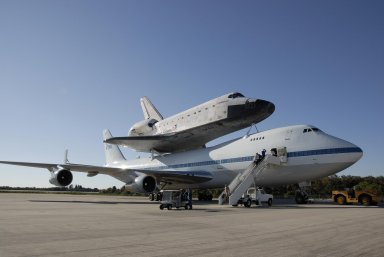
Atlantis completed STS-135, the last mission of the space shuttle program, with a landing at NASA's Kennedy Space Center in Florida on July 21.

O'Connor held management positions in NASA's space shuttle, International Space Station, and Shuttle-Mir programs, and played prominent safety management roles in the agency's recovery from two space shuttle accidents, the loss of Challenger in 1986 and the loss of Columbia in 2003. Prior to that, he joined NASA's astronaut corps in 1980 and flew two missions aboard the space shuttle.

Today’s wakeup song was “Don’t Panic,” by Coldplay, played at 9:59 p.m. EDT for space shuttle Atlantis Pilot Doug Hurley.

Hurley will guide Atlantis away from the International Space Station on a half-lap fly-around about an hour after the shuttle undocks at 2:28 a.m.

Atlantis Commander Chris Ferguson and Pilot Doug Hurley have reloaded software into General Purpose Computer (GPC) 4 and recovered the computer. It has been added to the common set of GPCs and is operating normally, processing data.

Meanwhile, Mission Control is evaluating the “dump” of data from the computer that Atlantis transmitted earlier this morning to determine what caused the Thursday evening failure. GPCs 1, 2 & 4 are in “run” and GPC 3 is in “standby.” All four of the primary computers are processing data.

In Firing Room 4 in the Launch Control Center at NASA's Kennedy Space Center in Florida, launch team members gather at their consoles preparing for space shuttle Atlantis' STS-135 mission to the International Space Station.

Atlantis and its crew of four are scheduled to lift off at 11:26 a.m. EDT on July 8 to deliver the Raffaello multi-purpose logistics module packed with supplies and spare parts to the station.

NASA's Hubble Space Telescope crossed another milestone in its space odyssey of exploration and discovery. On Monday, July 4, the Earth-orbiting observatory logged its one millionth science observation during a search for water in an exoplanet's atmosphere 1,000 light-years away.

"For 21 years Hubble has been the premier space science observatory, astounding us with deeply beautiful imagery and enabling ground-breaking science across a wide spectrum of astronomical disciplines," said NASA Administrator Charles Bolden. He piloted the space shuttle mission that carried Hubble to orbit. "The fact that Hubble met this milestone while studying a faraway planet is a remarkable reminder of its strength and legacy."

Although Hubble is best known for its stunning imagery of the cosmos, the millionth observation is a spectroscopic measurement, where light is divided into its component colors. These color patterns can reveal the chemical composition of cosmic sources.

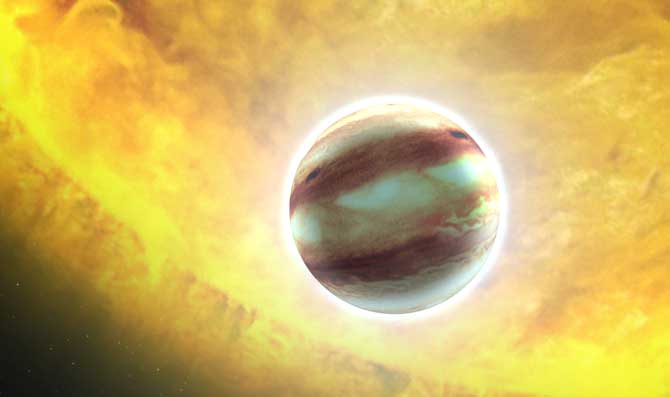
Hubble's millionth exposure is of the planet HAT-P-7b, a gas giant planet larger than Jupiter orbiting a star hotter than our sun. HAT-P-7b, also known as Kepler 2b, has been studied by NASA's planet-hunting Kepler observatory after it was discovered by ground-based observations. Hubble now is being used to analyze the chemical composition of the planet’s atmosphere.