NASA Probe Sees Solar Wind Decline
The 33-year odyssey of NASA's Voyager 1 spacecraft has reached a distant point at the edge of our solar system where there is no outward motion of solar wind. Now hurtling toward interstellar space some 17.4 billion...
Super-Earth Atmosphere
A team of astronomers, including two NASA Sagan Fellows, has made the first characterizations of a super-Earth's atmosphere, by using a ground-based telescope...
Kepler Discovers
NASA's Kepler spacecraft has discovered the first confirmed planetary system with more than one planet crossing in front of, or transiting, the same star...
During space shuttle Discovery's final spaceflight, the STS-133 crew members will take important spare parts to the International Space Station along with the Express Logistics Carrier-4.
Steve Bowen replaced Tim Kopra as Mission Specialist 2 following a bicycle injury on Jan. 15 that prohibited Kopra from supporting the launch window. Bowen last flew on Atlantis in May 2010 as part of the STS-132 crew. Flying on the STS-133 mission will make Bowen the first astronaut ever to fly on consecutive missions.
STS-134 Update:
Astronaut Rick Sturckow will serve as a backup commander for the STS-134 space shuttle mission to facilitate continued training for the crew and support teams during STS-134 Commander Mark Kelly's absence. Kelly's wife, Congresswoman Gabrielle Giffords, was critically wounded in a shooting on Jan. 8 in Tucson, Ariz. Kelly remains commander of the mission, which is targeted for launch on April 19 from NASA's Kennedy Space Center in Florida.
STS-135 Update:
The Space Shuttle Program baselined the STS-135 mission for a target launch date of June 28 at 3:48 p.m. EDT. It is NASA’s intent to fly the mission with orbiter Atlantis carrying the Raffaello multipurpose logistics module to deliver supplies, logistics and spare parts to the International Space Station. The mission also will fly a system to investigate the potential for robotically refueling existing spacecraft and return a failed ammonia pump module to help NASA better understand the failure mechanism and improve pump designs for future systems.
In late December, the agency’s Space Operations Mission Directorate requested the shuttle and International Space Station programs take the necessary steps to maintain the capability to fly Atlantis on the STS-135 mission. The Authorization Act of 2010 directs NASA to conduct the mission, and baselining the flight enables the program to begin preparations for the mission with a target launch date of June 28. The mission would be the 135th and final space shuttle flight.
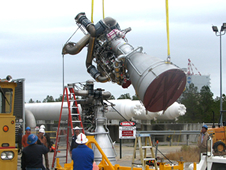
You see a lot of smiles around the E-1 Test Stand at John C. Stennis Space Center these days. Engineers involved in testing Aerojet's AJ26 rocket engine for Orbital Sciences Corporation's Taurus II space launch vehicle have good reason to smile.
In fact, they have several good reasons given that the partnership between NASA, Orbital and Aerojet is off to such an impressive start. Two successful tests of an AJ26 engine that will power the first stage of Orbital's Taurus II rocket recently wrapped up at Stennis. The two tests were so successful that Orbital engineers decided a planned third test was unnecessary. The AJ26 engine used in the testing was removed from the E-1 stand on Jan. 24, and will be returned to Aerojet in Sacramento, Calif. to be refurbished and used on an upcoming Taurus II mission.
The same day the engine was removed, the first flight engine was installed to begin regularly planned "acceptance testing" at Stennis. The AJ26 flight unit will be tested in February, and then delivered to Orbital at the Wallops Flight Facility launch site in Virginia for integration with the rocket's first stage core.
Orbital's Taurus II rocket will first be used to carry out commercial cargo supply mission to the International Space Station. Orbital is developing the cargo logistics system under the joint Commercial Orbital Transportation Services research and development project with NASA, and is scheduled to carry out the first of eight cargo missions under the Commercial Resupply Services contract beginning in early 2012.
NASA's Time History of Events and Macroscale Interaction during Substorms (THEMIS) spacecraft combined with computer models have helped track the origin of the energetic particles in Earth's magnetic atmosphere that appear during a kind of space weather called a substorm. Understanding the source of such particles and how they are shuttled through Earth's atmosphere is crucial to better understanding the Sun's complex space weather system and thus protect satellites or even humans in space.
The results show that these speedy electrons gain extra energy from changing magnetic fields far from the origin of the substorm that causes them. THEMIS, which consists of five orbiting satellites, helped provide these insights when three of the spacecraft traveled through a large substorm on February 15, 2008. This allowed scientists to track changes in particle energy over a large distance. The observations were consistent with numerical models showing an increase in energy due to changing magnetic fields, a process known as betatron acceleration.
"The origin of fast electrons in substorms has been a puzzle," says Maha Ashour-Abdalla, the lead author of a Nature Physics paper that appeared online on January 30, 2011 on the subject and a physicist at the University of California, Los Angeles. "It hasn't been clear until now if they got their burst of speed in the middle of the storm, or from some place further away."
Substorms originate opposite the sun on Earth's "night side," at a point about a third of the distance to the moon. At this point in space, energy and particles from the solar wind store up over time. This is also a point where the more orderly field lines near Earth -- where they look like two giant ears on either side of the globe, a shape known as a dipole since the lines bow down to touch Earth at the two poles – can distort into long lines and sometimes pull apart and "reconnect." During reconnection, the stored energy is released in explosions that send particles out in all directions. But reconnection is a magnetic phenomenon and scientists don't know the exact mechanism that creates speeding particles from that phenomenon.
"For thirty years, one of the questions about the magnetic environment around Earth has been, 'how do magnetic fields give rise to moving, energetic particles?'" says NASA scientist Melvyn Goldstein, chief of the Geospace Physics Laboratory at NASA’s Goddard Space Flight Center in Greenbelt, Md., and another author on the paper. "We need to know such things to help plan the next generation of reconnection research instruments such as the Magnetospheric MultiScale mission (MMS) due to launch in 2014. MMS needs to look in the right place and for the correct signatures of particle energization."
In the early 1980s, scientists hypothesized that the quick, high-energy particles might get their speed from rapidly changing magnetic fields. Changing magnetic fields can cause electrons to zoom along a corkscrew path by the betatron effect.
Indeed, electrons moving toward Earth from a substorm will naturally cross a host of changing magnetic fields as those long, stretched field lines far away from Earth relax back to the more familiar dipole field lines closer to Earth, a process called dipolarization. Betatron acceleration causes the particles to gain energy and speed much farther away from the initial reconnection site. But in the absence of observations that could simultaneously measure data near the reconnection site and closer to Earth, the hypothesis was hard to prove or contradict.
An artist's concept of the THEMIS spacecraft as it might appear in orbit. Credit: NASA THEMIS, however, was specifically designed to study the formation of substorms. It launched with five spacecraft, which can be spread out over some 44,000 miles – a perfect tool for examining different areas of Earth's magnetic environment at the same time. Near midnight, on February 15, 2008, three of the satellites moving through Earth's magnetic tail, about 36,000 miles from Earth, traveled through a large substorm.
"I looked at the THEMIS data for that substorm," says Ashour-Abdalla, "and saw there was a direct correlation of the increased particle energy at the origin with the region of dipolarization nearer to Earth."
To examine the data, Ashour-Abdalla and a team of researchers from UCLA, Nanchang University in China, NASA Goddard Space Flight Center, and the University of Maryland, Baltimore, used their expertise with computer modeling to simulate the complex dynamics that occur in space. The team began with spacecraft data from an ESA mission called Cluster that was in the solar wind at the time of the substorm. Using these observations of the solar environment, they modeled large scale electric and magnetic fields in space around Earth. Then they modeled the future fate of the various particles observed.
When the team looked at their models they saw that electrons near the reconnection sites didn't gain much energy. But as they looked closer to Earth, where the THEMIS satellites were located, their model showed particles that had some ten times as much energy – just as THEMIS had in fact observed.
This is consistent with the betatron acceleration model. The electrons gain a small amount of energy from the reconnection and then travel toward Earth, crossing many changing magnetic field lines. These fields produce betatronic acceleration just as Kivelson predicted in the early 1980s, speeding the electrons up substantially.
"This research shows the great science that can be accomplished when modelers, theorists and observationalists join forces," says astrophysicist Larry Kepko, who is a deputy project scientist for the THEMIS mission at Goddard. "THEMIS continues to yield critical insights into the dynamic processes that produce the space weather that affects Earth."
Launched in 2007, THEMIS was NASA's first five-satellite mission launched aboard a single rocket. The unique constellation of satellites provided scientists with data to help resolve the mystery of how Earth's magnetosphere stores and releases energy from the sun by triggering geomagnetic substorms. Two of the satellites have been renamed ARTEMIS and are in the process of moving to a new orbit around the moon. They are due to reach their final lunar orbit in July 2011. The three remaining THEMIS satellites continue to study substorms.
THEMIS is managed by NASA's Goddard Space Flight Center for the agency's Science Mission Directorate. The Space Sciences Laboratory at the University of California, Berkeley, is responsible for project management, space and ground-based instruments, mission integration, mission operations and science. ATK (formerly Swales Aerospace), Beltsville, Md., built the THEMIS probes. THEMIS is an international project conducted in partnership with Germany, France, Austria, and Canada.
Fifty years ago, a young President facing mounting pressure at home propelled a fledgling space agency on a bold, new course that would push the frontiers of exploration to new heights. Today, on this Day of Remembrance when NASA reflects on the mighty sacrifices made to push those frontiers, America’s space agency is working to achieve even greater goals. NASA’s new 21st Century course will foster new industries that create jobs, pioneer technology innovation, and inspire a new generation of explorers through education – all while continuing its fundamental missions of exploring our home planet and the cosmos.
Throughout history, however, we have seen that achieving great things sometimes comes at great cost and we mourn the brave astronauts who made the ultimate sacrifice in support of NASA missions throughout the agency’s storied history. We pause to reflect on the tragic loss of the Apollo 1 crew, those who boarded the space shuttle Challenger in search of a brighter future, and the brave souls who perished on the space shuttle Columbia.
Through triumph and tragedy, each of us has benefited from their courage and devotion, and we honor their memory by dedicating ourselves to a better tomorrow. Despite the challenges before us today, let us commit ourselves and continue their valiant journey toward a more vibrant and secure future.
NASA's Stardust spacecraft has downlinked its first images of comet Tempel 1, the target of a flyby planned for Valentine's Day, Feb. 14. The images were taken on Jan. 18 and 19 from a distance of 26.3 million kilometers (16.3 million miles), and 25.4 million kilometers (15.8 million miles) respectively. On Feb. 14, Stardust will fly within about 200 kilometers (124 miles) of the comet's nucleus.
"This is the first of many images to come of comet Tempel 1," said Joe Veverka, principal investigator of NASA's Stardust-NExT mission from Cornell University, Ithaca, N.Y. "Encountering something as small and fast as a comet in the vastness of space is always a challenge, but we are very pleased with how things are setting up for our Valentine's Day flyby."
The composite image is a combination of several images taken by Stardust's navigation camera. Future images will be used to help mission navigators refine Stardust's trajectory, or flight path, as it closes the distance between comet and spacecraft at a rate of about 950,000 kilometers (590,000 miles) a day. On the night of encounter, the navigation camera will be used to acquire 72 high-resolution images of the comet's surface features. Stardust-NExT mission scientists will use these images to see how surface features on comet Tempel 1 have changed over the past five-and-a-half years. (Tempel 1 had previously been visited and imaged in July of 2005 by NASA's Deep Impact mission).
Launched on Feb. 7, 1999, Stardust became the first spacecraft in history to collect samples from a comet (comet Wild 2), and return them to Earth for study. While its sample return capsule parachuted to Earth in January 2006, mission controllers were placing the still-viable spacecraft on a path that would allow NASA the opportunity to re-use the already-proven flight system if a target of opportunity presented itself. In January 2007, NASA re-christened the mission "Stardust-NExT" (New Exploration of Tempel), and the Stardust team began a four-and-a-half year journey for the spacecraft to comet Tempel 1. This will be the second exploration of Tempel 1 by a spacecraft.
Along with the high-resolution images of the comet's surface, Stardust-NExT will also measure the composition, size distribution and flux of dust emitted into the coma, and provide important new information on how Jupiter-family comets evolve and how they formed 4.6 billion years ago.
Stardust-NExT is a low-cost mission that will expand the investigation of comet Tempel 1 initiated by NASA's Deep Impact spacecraft. JPL, a division of the California Institute of Technology in Pasadena, manages Stardust-NExT for the NASA Science Mission Directorate, Washington, D.C. Joe Veverka of Cornell University, Ithaca, N.Y., is the mission's principal investigator. Lockheed Martin Space Systems, Denver, built the spacecraft and manages day-to-day mission operations.
NASA Administrator Charles Bolden meets with seventh and eighth grade students from Albert Hill Middle School this Friday at the MathScience Innovation Center in Richmond, Va. Bolden will highlight the importance of science, technology, engineering and math, or STEM, education as he shares his career experiences in the military and the space program. In his State of the Union speech on Tuesday, President Obama emphasized the importance of STEM education for the U.S. to remain competitive in the world and win the future.
U.S. Senator Mark Warner is scheduled to join the administrator and science center executives for this special NASA student event on Friday, Jan. 28, at 10 a.m. EST. Bolden's remarks will begin around 11 a.m.
Media representatives interested in attending should contact Robin Newton at 804-343-6525 x227 by 5 p.m. Thursday, Jan. 27. The MathScience Innovation Center is located at 2401 Hartman Street in Richmond.
The MathScience Innovation Center's goal is to be the innovator, incubator and advocate of 21st Century math and science programs for the Virginia-capital region's kindergarten through 12th grade educators and students. It also houses the Challenger Center Learning Center Richmond. January 28 will mark the 25th anniversary of the loss of space shuttle Challenger astronauts.
In his first education address of 2011, Bolden will reinforce NASA's commitment to STEM education and highlight opportunities for students who pursue those fields. STEM studies are a key part of NASA's effort to build the agency's future high-tech workforce and cultivate the next generation of explorers.
In addition to hearing from Bolden and Warner, the students will have an opportunity to engage in hands-on activities related to science and exploration. Education staff from NASA's Langley Research Center in Hampton, Va., will lead the activities.
NASA engineers successfully integrated and completed system testing on a new robotic lander recently at Teledyne Brown Engineering’s facility in Huntsville in support of the Robotic Lunar Lander Project at NASA's Marshall Space Flight Center in Huntsville, Ala.
The lander prototype was placed on modified skateboards and a customized track system as a low-cost solution to control movement during final testing of the prototype’s sensors, onboard computer, and thrusters. The functional test focused on ensuring that all system components work seamlessly to sense, communicate, and command the lander's movements.
The prototype will be transported to the United States Army Redstone Arsenal Test Center in Huntsville this week to begin strap-down testing, which will lead to free-flying tests later this year.
The lander prototype will aid NASA’s development of a new generation of small, smart, versatile landers for airless bodies such as the moon and asteroids. The lander's design is based on cutting-edge technology, which allows precision landing in high-risk, but high-priority areas, enabling NASA to achieve scientific and exploration goals in previously unexplored locations.
Development of the lander prototype is a cooperative endeavor led by the Robotic Lunar Lander Development Project at the Marshall Center, Johns Hopkins Applied Physics Laboratory of Laurel, Md., and the Von Braun Center for Science and Innovation, which includes the Science Applications Internatil Corporation, Dynetics Corp., Teledyne Brown Engineering Inc., and Millennium Engineering and Integration Company, all of Huntsville.
Seen in X-rays, the entire sky is aglow. Even far away from bright sources, X-rays originating from beyond our galaxy provide a steady glow in every direction. Astronomers have long suspected that the chief contributors to this cosmic X-ray background were dust-swaddled black holes at the centers of active galaxies. The trouble was, too few of them were detected to do the job.
An international team of scientists using data from NASA's Swift satellite confirms the existence of a largely unseen population of black-hole-powered galaxies. Their X-ray emissions are so heavily absorbed that little more than a dozen are known. Yet astronomers say that despite the deeply dimmed X-rays, the sources may represent the tip of the iceberg, accounting for at least one-fifth of all active galaxies.
"These heavily shrouded black holes are all around us," said Neil Gehrels, the Swift principal investigator at NASA's Goddard Space Flight Center in Greenbelt, Md., and a co-author of the new study. "But before Swift, they were just too faint and too obscured for us to see."
Most large galaxies contain a giant central black hole, and those observed in the Swift study weigh in at about 100 million times the sun's mass. In an active galaxy, matter falling toward the supermassive black hole powers high-energy emissions so intense that two classes of active galaxies, quasars and blazars, rank as the most luminous objects in the universe.
The X-ray background led astronomers to suspect that active galaxies were undercounted. Astronomers could never be certain that they had detected most of even the closest active galaxies. Thick clouds of dust and gas surround the central black hole and screen out ultraviolet, optical and low-energy (or soft) X-ray light. While infrared radiation can make it through the material, it can be confused with warm dust in the galaxy's star-forming regions.
However, some of the black hole's more energetic X-rays do penetrate the shroud, and that's where Swift comes in. Since 2004, Swift's Burst Alert Telescope (BAT), developed and operated at NASA Goddard, has been mapping the entire sky in hard X-rays with energies between 15,000 and 200,000 electron volts -- thousands of times the energy of visible light. Gradually building up its exposure year after year, the survey is now the largest, most sensitive and most complete census at these energies. It includes hundreds of active galaxies out to a distance of 650 million light-years.
From this sample, the researchers eliminated sources less than 15 degrees away from the dusty, crowded plane of our own galaxy. All active galaxies sporting an energetic particle jet were also not considered, leaving 199 galaxies.
Although there are many different types of active galaxy, astronomers explain the different observed properties based on how the galaxy angles into our line of sight. We view the brightest ones nearly face on, but as the angle increases, the surrounding ring of gas and dust absorbs increasing amounts of the black hole's emissions.
Astronomers assumed that there were many active galaxies oriented edgewise to us, but they just couldn't be detected because the disk of gas attenuates emissions too strongly.
"These extremely obscured active galaxies are very faint and difficult to find. Out of a sample of 199 sources, we detected only nine of them," said Davide Burlon, the lead author of the study and a graduate student at the Max Planck Institute for Extraterrestrial Physics in Munich.
"But even Swift's BAT has trouble finding these highly absorbed sources, and we know that the survey undercounts them," Burlon explained. "When we factored this in, we found that these shrouded active galaxies are very numerous, making up about 20 to 30 percent of the total."
"With Swift we have now quantified exactly how many active galaxies there are around us -- really, in our back yard," said Marco Ajello at the SLAC National Accelerator Laboratory, Menlo Park, Calif. "The number is large, and it agrees with models that say they are responsible for most of the X-ray background." If the numbers remain consistent at greater distances, when the universe was substantially younger, then there are enough supermassive black holes to account for the cosmic X-ray background.
The team then merged Swift BAT data with archived observations from its X-Ray Telescope in an effort to study how the intensity of the galaxies' emissions changed at different X-ray energies.
"This is the first time we could investigate the average spectrum of heavily absorbed active galaxies," said Ajello. "These galaxies are responsible for the shape of the cosmic X-ray background -- they create the peak of its energy."
All of this is consistent with the idea that the cosmic X-ray background is the result of emission from obscured supermassive black holes active when the universe was 7 billion years old, or about half its current age.
Swift, launched in November 2004, is managed by Goddard. It was built and is being operated in collaboration with Penn State, the Los Alamos National Laboratory in New Mexico, and General Dynamics in Falls Church, Va.; the University of Leicester and Mullard Space Sciences Laboratory in the United Kingdom; Brera Observatory and the Italian Space Agency in Italy; plus additional partners in Germany and Japan.
The next three crew members to live and work aboard the International Space Station will hold a news conference at 1 p.m. CST on Wednesday, Jan. 26 at NASA's Johnson Space Center in Houston. The news conference will be broadcast live on NASA Television and the agency's website. Questions will be taken from participating NASA centers.
NASA astronaut Ron Garan and crewmates, Russian cosmonauts Alexander Samokutyaev and Andrey Borisenko, will participate in individual round-robin interviews, in person or by phone, following the news conference. The crew also will participate in a photo opportunity for reporters at Johnson.
U.S. and foreign media representatives planning to attend the briefing or participate in the round-robin interviews must contact the Johnson newsroom at 281-483-5111 by 4 p.m. on Monday, Jan. 24.
Garan, Samokutyaev and Borisenko are three of the six crew members for Expedition 27 and 28. The trio is scheduled to launch to the station aboard a Russian Soyuz spacecraft from the Baikonur Cosmodrome in Kazakhstan on March 29 (March 30 Kazakhstan time). They will join Expedition 27 NASA astronaut Cady Coleman, European Space Agency astronaut Paolo Nespoli and Russian cosmonaut Dmitry Kondratyev who will stay aboard the station until mid-May.
A test photo of British Columbia's snow-capped West Coast Mountains is the first official image taken from the International Space Station's new Window Observational Research Facility, or WORF.
The image was taken to test the functionality of the control computer and camera associated with EarthKAM, an educational outreach project that allows Earth bound middle school students to take pictures of our home planet from the unique perspective of the space station, 220 miles above the Earth's surface. WORF was delivered to the station on the STS-131 mission of space shuttle Discovery in April 2010.
EarthKAM uses a Nikon D2X digital camera, and was set up in the WORF by Expedition 26 NASA flight engineer Cady Coleman on Jan. 17. EarthKAM ground controllers took the test photo. Expedition 26 also includes Commander Scott Kelly of NASA, European Space Agency astronaut Paolo Nespoli, and Russian cosmonauts Oleg Skripochka, Alexander Kaleri and Dmitry Kontratyev.
The test photo, designated ISS EarthKAM Image Winter 2011 #9362, is of an area of British Columbia, Canada, just north of Vancouver Island. The center point of the photo is 51 degrees, 48 minutes north and 127 degrees, 54 minutes west. Visible in the photo are Calvert and Hecate Islands on the Canadian coast and the southern portion of Hunter Island. Also visible are glaciers of the Ha-iltzuk Icefield near the 8,720-foot-tall - 2,658-meter-tall - Mount Somolenko. Mount Somolenko is a volcanic peak in southwestern British Columbia that lies in a circular volcanic depression in the Pacific Ranges of the Coast Mountains called the Silverthrone Caldera.
While this isn't a particularly unique Earth observation image, it is notable that even though it was taken with a wider angle, 50mm lens and covers an area 124 miles/200 kilometers, by 83 miles/134 kilometers, it can be enlarged by more than 400 percent while keeping features in the photo identifiable. This is made possible by the high-quality optics of the Earth-facing window of the Destiny Laboratory, which was launched on Feb. 7, 2001.
The installation of WORF allowed removal of an internal "scratch pane" that has reduced the quality of images taken though the window. WORF also provides a highly stable mounting platform to hold cameras and sensors rock steady at the window, as well as the power, command, data, and cooling connections needed for their operation.
"With the WORF finally in place we can now for the first time make full use of the investment we made in having an optical quality window onboard the station for Earth science and observation," said former astronaut Mario Runco, who was part of the design and development teams for the Destiny window and WORF, and now serves as NASA's lead for Spacecraft Window Optics and Window/WORF Utilization at NASA's Johnson Space Center, Houston.
"We are very excited to have a new camera system that appears to be functional and taking incredible images," said Karen Flammer, who manages EarthKAM operations at the University of California, can Diego. "The first student images were taken by Parkview Montessori in the Jackson-Madison County (Tenn.) School System, and Public School 229 - Dyker in Brooklyn, N.Y., part of the New York City Department of Education.
Parkview teacher Vickie LeCroy's students plan to study landforms, such as islands, mountains and deserts in the image they took of Mexico, and Dyker teacher Camille Fratantoni’s students plan to enrich their studies of earth science and learn more about NASA missions.
In addition to their educational outreach role with EarthKAM, the combination of the window and WORF adds to the station's capabilities as an Earth science remote sensing platform for high-resolution cameras and multi and hyperspectral imagers. Images from space have many applications, such as in the study of climate and meteorology; oceanography; geology and volcanology; coastal, agricultural, ranch and forestry management; and disaster assessments and management.
NASA's Marshall Space Flight Center in Huntsville, Ala., confirmed that the NanoSail-D nanosatellite deployed its 100-square-foot polymer sail in low-Earth orbit and is operating as planned. Actual deployment occurred on Jan. 20 at 10 p.m. EST and was confirmed today with beacon packets data received from NanoSail-D and additional ground-based satellite tracking assets. In addition, the NanoSail-D orbital parameter data set shows an appropriate change which is consistent with sail deployment.
"This is tremendous news and the first time NASA has deployed a solar sail in low-Earth orbit," said Dean Alhorn, NanoSail-D principal investigator and aerospace engineer at the Marshall Center. "To get to this point is an incredible accomplishment for our small team and I can't thank the amateur ham operator community enough for their help in tracking NanoSail-D. Their assistance was invaluable. In particular, the Marshall Amateur Radio Club was the very first to hear the radio beacon. It was exciting!"
It is estimated that NanoSail-D will remain in low-Earth orbit between 70 and 120 days, depending on atmospheric conditions. NanoSail-D is designed to demonstrate deployment of a compact solar sail boom technology. This research demonstration could lead to further advances of this alternative solar sail propulsion and the critical need for new de-orbit technologies. This ejection experiment also demonstrates a spacecraft’s ability, like the Fast, Affordable, Science and Technology Satellite, or FASTSAT, to eject a nano-satellite from a micro-satellite, while avoiding re-contact with the primary satellite.
"This is a significant accomplishment for both the FASTSAT and NanoSail-D projects. This accomplishment validates that we've met another of our primary mission objectives -- successfully ejecting a nanosatellite from an orbiting microsatellite," said Mark Boudreaux, FASTSAT project manager at the Marshall Center. "This is another significant accomplishment for our inter Agency, Industry and Governmental FASTSAT-HSV01 partnership team."
The team operating NASA's Mars rover Opportunity will temporarily suspend commanding for 16 days after the rover's seventh anniversary next week, but the rover will stay busy.
For the fourth time since Opportunity landed on Mars on Jan. 25, 2004, Universal Time , the planets' orbits will put Mars almost directly behind the sun from Earth's perspective.
During the days surrounding such an alignment, called a solar conjunction, the sun can disrupt radio transmissions between Earth and Mars. To avoid the chance of a command being corrupted by the sun and harming a spacecraft, NASA temporarily refrains from sending commands from Earth to Mars spacecraft in orbit and on the surface. This year, the commanding moratorium will be Jan. 27 to Feb. 11 for Opportunity, with similar periods for the Mars Reconnaissance Orbiter and Mars Odyssey orbiter.
Downlinks from Mars spacecraft will continue during the conjunction period, though at a much reduced rate. Mars-to-Earth communication does not present risk to spacecraft safety, even if transmissions are corrupted by the sun.
NASA's Mars Reconnaissance Orbiter will scale back its observations of Mars during the conjunction period due to reduced capability to download data to Earth and a limit on how much can be stored onboard.
Opportunity will continue sending data daily to the Odyssey orbiter for relay to Earth. "Overall, we expect to receive a smaller volume of daily data from Opportunity and none at all during the deepest four days of conjunction," said Alfonso Herrera, a rover mission manager at NASA's Jet Propulsion Laboratory, Pasadena, Calif.
The rover team has developed a set of commands to be sent to Opportunity in advance so that the rover can continue science activities during the command moratorium.
"The goal is to characterize the materials in an area that shows up with a mineralogical signal, as seen from orbit, that's different from anywhere else Opportunity has been," said JPL's Bruce Banerdt, project scientist for Opportunity and its rover twin, Spirit. The area is at the southeastern edge of a crater called "Santa Maria," which Opportunity approached from the west last month.
Drives last week brought Opportunity to the position where it will spend the conjunction period. From that position, the rover's robotic arm can reach an outcrop target called "Luis de Torres." The rover's Moessbauer spectrometer will be placed onto the target for several days during the conjunction to assess the types of minerals present. The instrument uses a small amount of radioactive cobalt-57 to elicit information from the target. With a half-life of less than a year, the cobalt has substantially depleted during Opportunity's seven years on Mars, so readings lasting several days are necessary now to be equivalent to much shorter readings when the mission was newer.
Opportunity will also make atmospheric measurements during the conjunction period. After conjunction, it will spend several more days investigating Santa Maria crater before resuming a long-term trek toward Endurance crater, which is about 22 kilometers (14 miles) in diameter and, at its closest edge, about 6 kilometers (4 miles) from Santa Maria.
Opportunity's drives to the southeastern edge of Santa Maria brought the total distance driven by the rover during its seventh year on Mars to 7.4 kilometers (4.6 miles), which is more than in any previous year. The rover's total odometry for its seventh anniversary is 26.7 kilometers (16.6 miles).