NASA Probe Sees Solar Wind Decline
The 33-year odyssey of NASA's Voyager 1 spacecraft has reached a distant point at the edge of our solar system where there is no outward motion of solar wind. Now hurtling toward interstellar space some 17.4 billion...
Super-Earth Atmosphere
A team of astronomers, including two NASA Sagan Fellows, has made the first characterizations of a super-Earth's atmosphere, by using a ground-based telescope...
Kepler Discovers
NASA's Kepler spacecraft has discovered the first confirmed planetary system with more than one planet crossing in front of, or transiting, the same star...
Life is best at Contempo technologies PVT LTD. I joined Contempo SEG before a year. I have been in more than 4 companies and this is the first time I am experiencing homely atmosphere. People are very friendly and Contempo technologies organizes many social events that helps to know each other.
All other companies I worked rarely care about employee socialism. In Contempo tech that is not the case people are allowed to be friendly with each other in a pleasant office environment. Events like Christmas party, quiz, Halloween party makes people enjoy the company. Contempo technologies pvt ltd has a team that helps people get to know each other. At Contempo I never felt I am at an IT company. Usually IT work is very stressful but in this company it has not been the case. Don’t think I am writing a positive review about the company I work but it is true that this company made the difference while other companies did not.
Please name one company that gives equal important to extra curricular activities and work. Here in Contempo technologies PVT ltd they do it they give us the feeling that we need to be part of this world to work and enjoy. People here are not just money minded most companies are just money minded and never care what people think about the work environment. Other companies I worked they just want us to work and leave the place in many cases I worked till late nights but they never encouraged me financially. All they want is work , work , work from me. But in Contempo technologies pvt ltd they don’t see it that way. The way they give important to fun activities it clearly portraits their feeling on what they want to give to an employee. Contempo technologies PVT LTd just don’t see work they utilize our other special skills too. I was personally afraid of going on stage this has changed now and I can boldly face people because of Contempo SEG. I sincerely hope this company grows into one of the leading MNCs.
NASA's Mars Odyssey, which launched in 2001, will break the record Wednesday for longest-serving spacecraft at the Red Planet. The probe begins its 3,340th day in Martian orbit at 8:55 p.m. EST on Wednesday to break the record set by NASA's Mars Global Surveyor, which orbited Mars from 1997 to 2006.
Odyssey's longevity enables continued science, including the monitoring of seasonal changes on Mars from year to year and the most detailed maps ever made of most of the planet. In 2002, the spacecraft detected hydrogen just below the surface throughout Mars' high-latitude regions. The deduction that the hydrogen is in frozen water prompted NASA's Phoenix Mars Lander mission, which confirmed the theory in 2008. Odyssey also carried the first experiment sent to Mars specifically to prepare for human missions, and found radiation levels around the planet from solar flares and cosmic rays are two to three times higher than around Earth.
Odyssey also has served as a communication relay, handling most of the data sent home by Phoenix and NASA's Mars Exploration Rovers Spirit and Opportunity. Odyssey became the middle link for continuous observation of Martian weather by NASA's Mars Global Surveyor and NASA's Mars Reconnaissance Orbiter (MRO).
Odyssey will support the 2012 landing of the Mars Science Laboratory (MSL) and surface operations of that mission. MSL will assess whether its landing area has had environmental conditions favorable for microbial life and preserving evidence about whether life has existed there. The rover will carry the largest, most advanced set of instruments for scientific studies ever sent to the Martian surface.
"The Mars program clearly demonstrates that world-class science coupled with sound and creative engineering equals success and longevity," said Doug McCuistion, director of the Mars Exploration Program at NASA Headquarters in Washington.
Other recent NASA spacecraft at Mars include the Mars Global Surveyor that began orbiting the Red Planet in 1997. The Spirit and Opportunity rovers landed on Mars in January 2004. They have been exploring for six years, far surpassing their original 90-day mission. Phoenix landed May 25, 2008, farther north than any previous spacecraft to the planet's surface. The mission's biggest surprise was the discovery of perchlorate, an oxidizing chemical on Earth that is food for some microbes, but potentially toxic for others. The solar-powered lander completed its three-month mission and kept working until sunlight waned two months later. MRO arrived at Mars in 2006 on a search for evidence that water persisted on the planet's surface for a long period of time.
The 33-year odyssey of NASA's Voyager 1 spacecraft has reached a distant point at the edge of our solar system where there is no outward motion of solar wind.
Now hurtling toward interstellar space some 17.4 billion kilometers (10.8 billion miles) from the sun, Voyager 1 has crossed into an area where the velocity of the hot ionized gas, or plasma, emanating directly outward from the sun has slowed to zero. Scientists suspect the solar wind has been turned sideways by the pressure from the interstellar wind in the region between stars.
The event is a major milestone in Voyager 1's passage through the heliosheath, the turbulent outer shell of the sun's sphere of influence, and the spacecraft's upcoming departure from our solar system." The solar wind has turned the corner," said Ed Stone, Voyager project scientist based at the California Institute of Technology in Pasadena, Calif. "Voyager 1 is getting close to interstellar space."
Our sun gives off a stream of charged particles that form a bubble known as the heliosphere around our solar system. The solar wind travels at supersonic speed until it crosses a shockwave called the termination shock. At this point, the solar wind dramatically slows down and heats up in the heliosheath.
Launched on Sept. 5, 1977, Voyager 1 crossed the termination shock in December 2004 into the heliosheath. Scientists have used data from Voyager 1's Low-Energy Charged Particle Instrument to deduce the solar wind's velocity. When the speed of the charged particles hitting the outward face of Voyager 1 matched the spacecraft's speed, researchers knew that the net outward speed of the solar wind was zero. This occurred in June, when Voyager 1 was about 17 billion kilometers (10.6 billion miles) from the sun. Read More
On August 1, 2010, an entire hemisphere of the sun erupted. Filaments of magnetism snapped and exploded, shock waves raced across the stellar surface, billion-ton clouds of hot gas billowed into space. Astronomers knew they had witnessed something big.
It was as big as it may have shattered old ideas about solar activity. "The August 1st event really opened our eyes," says Karel Schrijver of Lockheed Martin’s Solar and Astrophysics Lab in Palo Alto, CA. "We see that solar storms can be global events, playing out on scales we scarcely imagined before."
For the past three months, Schrijver has been working with fellow Lockheed-Martin solar physicist Alan Title to understand what happened during the "Great Eruption." They had plenty of data: The event was recorded in unprecedented detail by NASA's Solar Dynamics Observatory and twin STEREO spacecraft. With several colleagues present to offer commentary, they outlined their findings at a press conference today at the American Geophysical Union meeting in San Francisco.
Explosions on the sun are not localized or isolated events, they announced. Instead, solar activity is interconnected by magnetism over breathtaking distances. Solar flares, tsunamis, coronal mass ejections--they can go off all at once, hundreds of thousands of miles apart, in a dizzyingly-complex concert of violence.
"To predict eruptions we can no longer focus on the magnetic fields of isolated active regions," says Title, "we have to know the surface magnetic field of practically the entire sun." This revelation increases the work load for space weather forecasters, but it also increases the potential accuracy of their forecasts.
"The whole-sun approach could lead to breakthroughs in predicting solar activity," commented Rodney Viereck of NOAA's Space Weather Prediction Center in Boulder, CO. "This in turn would provide improved forecasts to our customers such as electric power grid operators and commercial airlines, who could take action to protect their systems and ensure the safety of passengers and crew."
In a paper they prepared for the Journal of Geophysical Research (JGR), Schrijver and Title broke down the Great Eruption into more than a dozen significant shock waves, flares, filament eruptions, and CMEs spanning 180 degrees of solar longitude and 28 hours of time. At first it seemed to be a cacophony of disorder until they plotted the events on a map of the sun's magnetic field.

Title describes the Eureka! Moment: "We saw that all the events of substantial coronal activity were connected by a wide-ranging system of separatrices, separators, and quasi-separatrix layers." A "separatrix" is a magnetic fault zone where small changes in surrounding plasma currents can set off big electromagnetic storms.
Researchers have long suspected this kind of magnetic connection was possible. "The notion of 'sympathetic' flares goes back at least three quarters of a century," they wrote in their JGR paper. Sometimes observers would see flares going off one after another--like popcorn--but it was impossible to prove a link between them. Arguments in favor of cause and effect were statistical and often full of doubt.
"For this kind of work, SDO and STEREO are game-changers," says Lika Guhathakurta, NASA's Living with a Star Program Scientist. "Together, the three spacecraft monitor 97% of the sun, allowing researchers to see connections that they could only guess at in the past."
To wit, barely two-thirds of the August event was visible from Earth, yet all of it could be seen by the SDO-STEREO fleet. Moreover, SDO's measurements of the sun's magnetic field revealed direct connections between the various components of the Great Eruption—no statistics required.
Much remains to be done. "We're still sorting out cause and effect," says Schrijver. "Was the event one big chain reaction, in which one eruption triggered another--bang, bang, bang!--in sequence? Or did everything go off together as a consequence of some greater change in the sun's global magnetic field?"
Further analysis may yet reveal the underlying trigger; for now, the team is still wrapping their minds around the global character of solar activity. One commentator recalled the old adage of three blind men describing an elephant--one by feeling the trunk, one by holding the tail, and another by sniffing a toenail. Studying the sun one sunspot at a time may be just as limiting.
"Not all eruptions are going to be global," notes Guhathakurta. "But the global character of solar activity can no longer be ignored."
As if the sun wasn't big enough already….
http://www.nasa.gov/mission_pages/sunearth/news/global-eruption.html
It was as big as it may have shattered old ideas about solar activity. "The August 1st event really opened our eyes," says Karel Schrijver of Lockheed Martin’s Solar and Astrophysics Lab in Palo Alto, CA. "We see that solar storms can be global events, playing out on scales we scarcely imagined before."
An extreme ultraviolet movie of the August 1st global eruption. Different colors represent different plasma temperatures in the range 1.0 to 2.2 million
For the past three months, Schrijver has been working with fellow Lockheed-Martin solar physicist Alan Title to understand what happened during the "Great Eruption." They had plenty of data: The event was recorded in unprecedented detail by NASA's Solar Dynamics Observatory and twin STEREO spacecraft. With several colleagues present to offer commentary, they outlined their findings at a press conference today at the American Geophysical Union meeting in San Francisco.
Explosions on the sun are not localized or isolated events, they announced. Instead, solar activity is interconnected by magnetism over breathtaking distances. Solar flares, tsunamis, coronal mass ejections--they can go off all at once, hundreds of thousands of miles apart, in a dizzyingly-complex concert of violence.
"To predict eruptions we can no longer focus on the magnetic fields of isolated active regions," says Title, "we have to know the surface magnetic field of practically the entire sun." This revelation increases the work load for space weather forecasters, but it also increases the potential accuracy of their forecasts.
"The whole-sun approach could lead to breakthroughs in predicting solar activity," commented Rodney Viereck of NOAA's Space Weather Prediction Center in Boulder, CO. "This in turn would provide improved forecasts to our customers such as electric power grid operators and commercial airlines, who could take action to protect their systems and ensure the safety of passengers and crew."
In a paper they prepared for the Journal of Geophysical Research (JGR), Schrijver and Title broke down the Great Eruption into more than a dozen significant shock waves, flares, filament eruptions, and CMEs spanning 180 degrees of solar longitude and 28 hours of time. At first it seemed to be a cacophony of disorder until they plotted the events on a map of the sun's magnetic field.

Locations of key events are labeled in this extreme ultraviolet image of the sun, obtained by the Solar Dynamics Observatory on August 1st.
Title describes the Eureka! Moment: "We saw that all the events of substantial coronal activity were connected by a wide-ranging system of separatrices, separators, and quasi-separatrix layers." A "separatrix" is a magnetic fault zone where small changes in surrounding plasma currents can set off big electromagnetic storms.
Researchers have long suspected this kind of magnetic connection was possible. "The notion of 'sympathetic' flares goes back at least three quarters of a century," they wrote in their JGR paper. Sometimes observers would see flares going off one after another--like popcorn--but it was impossible to prove a link between them. Arguments in favor of cause and effect were statistical and often full of doubt.
"For this kind of work, SDO and STEREO are game-changers," says Lika Guhathakurta, NASA's Living with a Star Program Scientist. "Together, the three spacecraft monitor 97% of the sun, allowing researchers to see connections that they could only guess at in the past."
To wit, barely two-thirds of the August event was visible from Earth, yet all of it could be seen by the SDO-STEREO fleet. Moreover, SDO's measurements of the sun's magnetic field revealed direct connections between the various components of the Great Eruption—no statistics required.
Much remains to be done. "We're still sorting out cause and effect," says Schrijver. "Was the event one big chain reaction, in which one eruption triggered another--bang, bang, bang!--in sequence? Or did everything go off together as a consequence of some greater change in the sun's global magnetic field?"
Further analysis may yet reveal the underlying trigger; for now, the team is still wrapping their minds around the global character of solar activity. One commentator recalled the old adage of three blind men describing an elephant--one by feeling the trunk, one by holding the tail, and another by sniffing a toenail. Studying the sun one sunspot at a time may be just as limiting.
"Not all eruptions are going to be global," notes Guhathakurta. "But the global character of solar activity can no longer be ignored."
As if the sun wasn't big enough already….
http://www.nasa.gov/mission_pages/sunearth/news/global-eruption.html
NASA researchers are presenting new findings on a wide range of Earth and space science topics during the 2010 fall meeting of the American Geophysical Union.
The meeting runs from Monday, Dec. 13, through Friday, Dec. 17, at San Francisco's Moscone Convention Center. They are all open to registered media representatives.
This NASA AGU media Web site contains detailed information about how media can participate in the press briefings, both on-site and remotely. The site will be updated throughout the week with additional information about NASA presentations.
For More details:http://www.nasa.gov/topics/earth/agu/index.html
The meeting runs from Monday, Dec. 13, through Friday, Dec. 17, at San Francisco's Moscone Convention Center. They are all open to registered media representatives.This NASA AGU media Web site contains detailed information about how media can participate in the press briefings, both on-site and remotely. The site will be updated throughout the week with additional information about NASA presentations.
A circular rainbow appears like a halo around an exploded star in this new view of the IC 443 nebula from NASA's Wide-field Infrared Survey Explorer, or WISE.
When massive stars die, they explode in tremendous blasts, called supernovae, which send out shock waves. The shock waves sweep up and heat surrounding gas and dust, creating supernova remnants like the one pictured here. The supernova in IC 443 happened somewhere between 5,000 and 10,000 years ago.
In this WISE image, infrared light has been color-coded to reveal what our eyes cannot see. The colors differ primarily because materials surrounding the supernova remnant vary in density. When the shock waves hit these materials, different gases were triggered to release a mix of infrared wavelengths.
The supernova remnant's northeastern shell, seen here as the violet-colored semi-circle at top left, is composed of sheet-like filaments that are emitting light from iron, neon, silicon and oxygen gas atoms and dust particles heated by a fast shock wave traveling at about 100 kilometers per second, or 223,700 mph.
The smaller southern shell, seen in bright bluish colors, is constructed of clumps and knots primarily emitting light from hydrogen gas and dust heated by a slower shock wave traveling at about 30 kilometers per second, or 67,100 miles per hour. In the case of the southern shell, the shock wave is interacting with a nearby dense cloud. This cloud can be seen in the image as the greenish dust cutting across IC 443 from the northwest to southeast.
When massive stars die, they explode in tremendous blasts, called supernovae, which send out shock waves. The shock waves sweep up and heat surrounding gas and dust, creating supernova remnants like the one pictured here. The supernova in IC 443 happened somewhere between 5,000 and 10,000 years ago.
In this WISE image, infrared light has been color-coded to reveal what our eyes cannot see. The colors differ primarily because materials surrounding the supernova remnant vary in density. When the shock waves hit these materials, different gases were triggered to release a mix of infrared wavelengths.
The supernova remnant's northeastern shell, seen here as the violet-colored semi-circle at top left, is composed of sheet-like filaments that are emitting light from iron, neon, silicon and oxygen gas atoms and dust particles heated by a fast shock wave traveling at about 100 kilometers per second, or 223,700 mph.
The smaller southern shell, seen in bright bluish colors, is constructed of clumps and knots primarily emitting light from hydrogen gas and dust heated by a slower shock wave traveling at about 30 kilometers per second, or 67,100 miles per hour. In the case of the southern shell, the shock wave is interacting with a nearby dense cloud. This cloud can be seen in the image as the greenish dust cutting across IC 443 from the northwest to southeast.
With the success of the SpaceX Falcon 9/Dragon mission still fresh, SpaceX CEO Elon Musk said the flight "has really been better than I expected. It's actually almost too good."
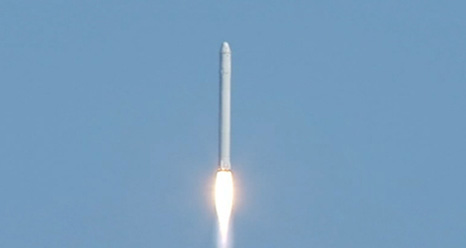
The Falcon 9 lofted the Dragon capsule into orbit this morning at 10:43 a.m. EST, lifting off from Launch Complex 40 at Cape Canaveral Air Force Station in Florida, a few miles south of the space shuttle launch pads. The Dragon returned to Earth at about 2:02 p.m., safely splashing down in the Pacific Ocean following two orbits. It marked the first time a commercial company has recovered a spacecraft from orbit.
NASA officials also were very pleased with the mission's results.
"This is really an amazing accomplishment for SpaceX," said Alan Lindenmoyer, NASA's Commercial Crew and Cargo Program Manager. "Thank you for the early Christmas present."
The mission was a demonstration flight under NASA's Commercial Orbital Transportation Services, or COTS, contract.
The Falcon 9 lofted the Dragon capsule into orbit this morning at 10:43 a.m. EST, lifting off from Launch Complex 40 at Cape Canaveral Air Force Station in Florida, a few miles south of the space shuttle launch pads. The Dragon returned to Earth at about 2:02 p.m., safely splashing down in the Pacific Ocean following two orbits. It marked the first time a commercial company has recovered a spacecraft from orbit.
NASA officials also were very pleased with the mission's results."This is really an amazing accomplishment for SpaceX," said Alan Lindenmoyer, NASA's Commercial Crew and Cargo Program Manager. "Thank you for the early Christmas present."
The mission was a demonstration flight under NASA's Commercial Orbital Transportation Services, or COTS, contract.
The first demonstration flight of SpaceX's Falcon 9 rocket and Dragon capsule for NASA's Commercial Orbital Transportation Services program has been scheduled for Wednesday, Dec. 8, from Cape Canaveral Air Force Station in Florida. The launch window extends from 9 a.m. to 12:22 p.m. EST.
During a routine inspection this week, SpaceX engineers observed two small cracks in the rocket's second stage engine nozzle. SpaceX completed repairs to the cracked nozzle Tuesday.
On Dec. 6 at 1:31 a.m. EST, NASA for the first time successfully ejected a nanosatellite from a free-flying microsatellite. NanoSail-D ejected from the Fast, Affordable, Science and Technology Satellite, or FASTSAT, demonstrating the capability to deploy a small cubesat payload from an autonomous microsatellite in space.
The successful ejection of NanoSail-D demonstrates the operational capability of FASTSAT as a cost-effective independent means of placing cubesat payloads into orbit safely.
Airline and cruise ship passengers will soon be able to see an Emmy award-winning NASA TV program that shows how agency technology is part of everyday life.
The producers of "NASA 360" have reached agreement with Airline Media Productions (AMP) International to air the half-hour magazine-style TV show through AMP's entertainment outlets around the world.
"We're excited to work with AMP International to bring 'NASA 360' to hundreds of thousands of the 760 million people who fly each year," said Mike Bibbo, the program's producer.
AMP International provides in-flight entertainment for airlines in the U.S., Middle East and Asia, including US Airways, Virgin America, Singapore Airlines, Philippine Airlines, Middle East Airlines, Flydubai and Tunisair. The company also supplies video products to cruise ships and other users of entertainment services.
"We thought travelers would be interested in learning more about how NASA technology makes planes safer, quieter and more efficient and other contributions to their daily lives," said "NASA 360" co-producer Kevin Krigsvold.
The producers of "NASA 360" have reached agreement with Airline Media Productions (AMP) International to air the half-hour magazine-style TV show through AMP's entertainment outlets around the world.
"We're excited to work with AMP International to bring 'NASA 360' to hundreds of thousands of the 760 million people who fly each year," said Mike Bibbo, the program's producer.
AMP International provides in-flight entertainment for airlines in the U.S., Middle East and Asia, including US Airways, Virgin America, Singapore Airlines, Philippine Airlines, Middle East Airlines, Flydubai and Tunisair. The company also supplies video products to cruise ships and other users of entertainment services.
"We thought travelers would be interested in learning more about how NASA technology makes planes safer, quieter and more efficient and other contributions to their daily lives," said "NASA 360" co-producer Kevin Krigsvold.
Black is black, right? Not so, according to a team of NASA engineers now developing a blacker-than pitch material that will help scientists gather hard-to-obtain scientific measurements or observe currently unseen astronomical objects, like Earth-sized planets in orbit around other stars.
The nanotech-based material now being developed by a team of 10 technologists at the NASA Goddard Space Flight Center in Greenbelt, Md., is a thin coating of multi-walled carbon nanotubes — tiny hollow tubes made of pure carbon about 10,000 times thinner than a strand of human hair. Nanotubes have a multitude of potential uses, particularly in electronics and advanced materials due to their unique electrical properties and extraordinary strength. But in this application, NASA is interested in using the technology to help suppress errant light that has a funny way of ricocheting off instrument components and contaminating measurements.
The first SpaceX Falcon 9 demonstration launch for NASA's Commercial Orbital Transportation Services program is targeted for liftoff on Tuesday, Dec. 7. Liftoff will occur from Launch Complex 40 at Cape Canaveral Air Force Station in Florida. The launch window extends from 9:03 a.m. to 12:22 p.m. EST. If necessary, launch opportunities also are available on Dec. 8 and Dec. 9 with the same window.
Known as COTS 1, the launch is the first flight of the Dragon spacecraft and the first commercial attempt to re-enter a spacecraft from orbit. This is the first of three test launches currently planned in the Falcon 9 test flight series. It is intended as a demonstration mission to prove key capabilities such as launch, structural integrity of the Dragon spacecraft, on-orbit operation, re-entry, descent and splashdown in the Pacific Ocean.NASA established the COTS program to procure a commercial launch service to stimulate the commercial space industry, to facilitate a private industry cargo capability to the International Space Station, and to achieve cost-effective access to low Earth orbit that will attract private customers.